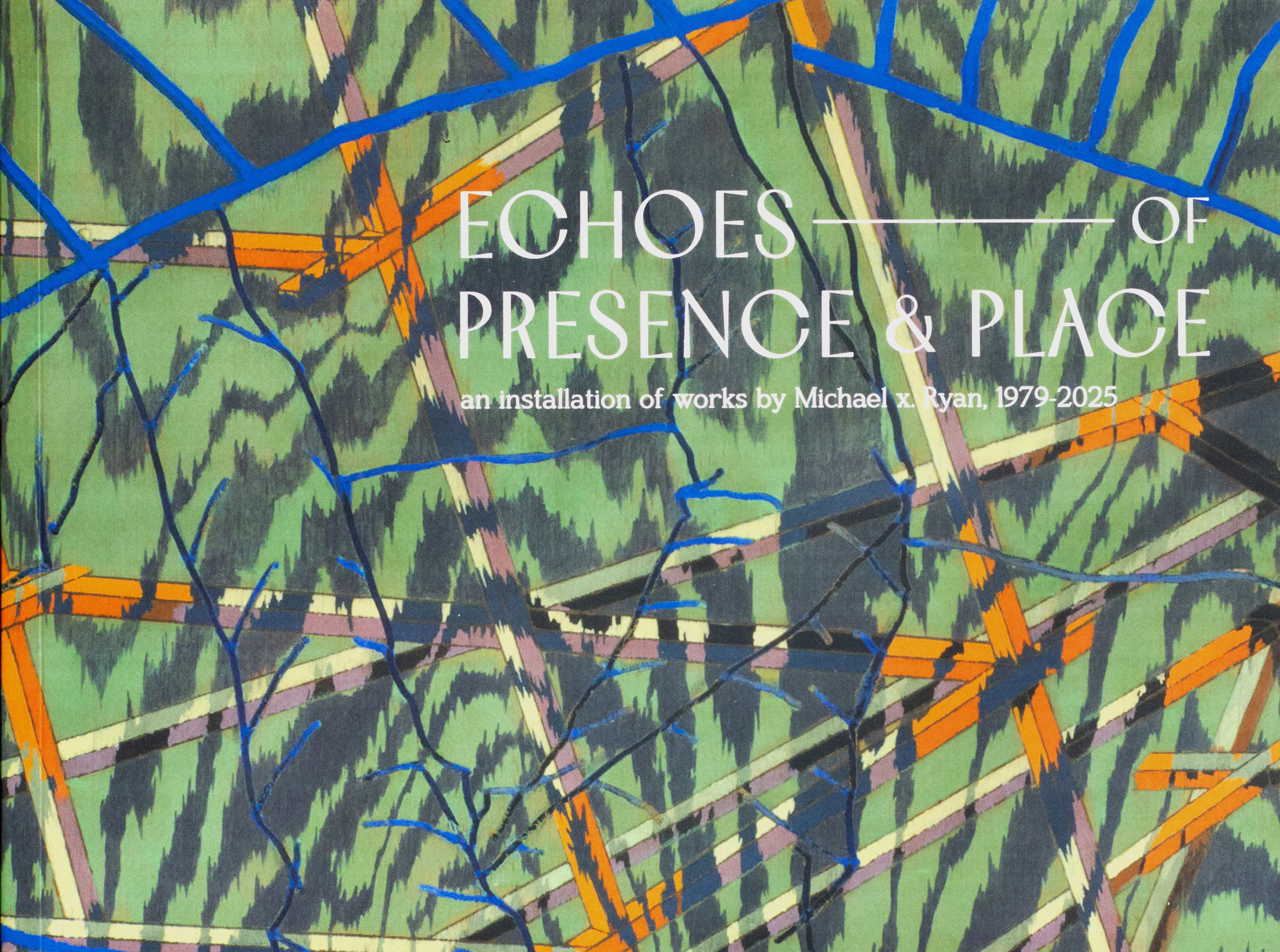
Carrie Johnson, Rockford Art Museum
To encounter the work of Michael x. Ryan is to step into a space of quiet attention—where the hum of the ordinary becomes extraordinary. Over four decades, Ryan has developed a practice that resists spectacle in favor of stillness. In Echoes of Presence and Place, we are invited to look closely—not just at the art, but at the subtle traces of human life that often go unnoticed.
Ryan’s process begins not in the studio, but in the world: walking, observing, recording. A puddle drying on pavement, an oil stain on the road, the faint imprint of a body pressed against a surface—these ephemeral encounters become the foundation for work that feels both intimate and enduring. His restraint gives the work its strength. These are not declarations, but quiet reflections—suggesting that meaning lies not in grand gestures, but in the smallest marks we leave behind.
Raised in Syracuse, New York, during a period of rapid suburban expansion, Ryan witnessed the transformation of forests into roads and homes. This early experience shaped his sensitivity to shifting landscapes and the fragile threshold between the natural and built environments. His work does not merely document these changes; it meditates on them—turning disappearance into presence, and memory into form.
In series like Chicago Roadstains, Ryan uses the worn surfaces of the city to reveal the subtle imprints of human movement and time. Oil slicks, residue of a spill, and footprints become the basis for large wood reliefs and drawings. In more intimate works like Body Press – Ghosts and Shower Puddle, the artist turns inward, capturing the brief contact between his own body and its surroundings. The result is a quiet archive of presence—his and ours.
Ryan’s wood reliefs begin with a stain or residue, reinterpreted as abstract, almost topographic shapes. These pieces do not announce themselves; they unfold gradually, like memory—layered, partial, and emotionally resonant. They remind us that landscapes are never neutral; they are shaped by our presence, just as we are shaped by them.
Echoes of Presence and Place is more than an exhibition—it’s a map of sustained attention. Ryan’s work invites us to notice what we usually overlook. To see a footprint not as residue, but as witness. To recognize in ordinary markings a record of time, presence, and the fragile ways we inhabit the world.
As we move through this installation, we don’t just view works on a wall—we walk alongside Ryan, across the terrain of memory and experience. In doing so, we may find ourselves rethinking what it means to be present, and what it means to leave a mark.
Stephanie Cristello, INdependent Curator and Author, Chicago, IL
Across each of the works in Echoes of Presence and Place—an installation of works by the Chicago-based artist Michael x. Ryan (b. 1956, Syracuse, NY), completed from 1979–2025—there is a recurring question: Where am I?
You get the sense the artist is asking himself at every turn. Both as distinct entities and in relation to one another, Ryan’s installations provide statements of position—coordinates, markers, measured distances—in response to this elemental call for orientation. They are not navigational in any conventional sense, nor do they offer destinations to which a viewer can necessarily return. His are maps to an alternate world’s geography, where whole countries grow from the puddle around your footprint as you step out of the shower and where the edges of a territory follow the contour of a spill on a sidewalk.Borders drawn by the faint imprint left by the wash of a wave upon the shore. Ryan documents these and other fleeting encounters with remarkable fidelity to detail—locating himself in space and time, while transforming lived observations into conceptual propositions.
I am walking upon the shoreline.
In Ox-Bow Water-line: a 20-foot line traced from a steel wire drawing following the water's edge from the Ox-Bow dock 20 feet north on Monday, July 7th, 2008 at 10:30am (2009–ongoing), Ryan reinstates the residue of a single moment captured during his time at the storied artist residency in Saugatuck, MI, situated on Lake Michigan. The work is created by carefully sifting sand onto the same to-scale wooden template the artist made from what was measured and catalogued that morning. Since then, it has been repeated, remade, and rehearsed for nearly two decades. Each iteration stretches a fleeting instant across time, shifting its scale from the ephemeral to the geologic—from a passing trace into a metaphor for the human urge to inscribe itself within natural history. The act is both obsessive and tender: a gesture that resists the immediacy of experience in favor of persistence, as if to argue with time itself.
In Ox-Bow Water-line: a 20-foot line traced from a steel wire drawing following the water's edge from the Ox-Bow dock 20 feet north on Monday, July 7th, 2008 at 10:30am (2009–ongoing), Ryan reinstates the residue of a single moment captured during his time at the storied artist residency in Saugatuck, MI, situated on Lake Michigan. The work is created by carefully sifting sand onto the same to-scale wooden template the artist made from what was measured and catalogued that morning. Since then, it has been repeated, remade, and rehearsed for nearly two decades. Each iteration stretches a fleeting instant across time, shifting its scale from the ephemeral to the geologic—from a passing trace into a metaphor for the human urge to inscribe itself within natural history. The act is both obsessive and tender: a gesture that resists the immediacy of experience in favor of persistence, as if to argue with time itself.
I am just around the corner.
In Ant Farm Self-Portrait: Where did I travel within the Chicago city limits from mid-February through early March during the years 1999 - 2000 - 2001? (1999–2004), the artist inscribes maps with passages of ink drawn and redrawn as it bleeds into thin paper. Through these repetitive marks—the product of daily routines—Ryan transforms the act of moving through the city into a form of self-portraiture. His Chicago Roadstains series, which began in 2004, similarly engages with the urban environment. The monochromatic bas-reliefs meticulously render the various spills the artist encountered on patches of pavement across Chicago, traced in the early or late hours of the morning on hands and knees, before returning to his studio to carve their outlines into sheets of plywood. The resulting sculptures appear scientific, as if their topographies were natural occurrences.
In Ant Farm Self-Portrait: Where did I travel within the Chicago city limits from mid-February through early March during the years 1999 - 2000 - 2001? (1999–2004), the artist inscribes maps with passages of ink drawn and redrawn as it bleeds into thin paper. Through these repetitive marks—the product of daily routines—Ryan transforms the act of moving through the city into a form of self-portraiture. His Chicago Roadstains series, which began in 2004, similarly engages with the urban environment. The monochromatic bas-reliefs meticulously render the various spills the artist encountered on patches of pavement across Chicago, traced in the early or late hours of the morning on hands and knees, before returning to his studio to carve their outlines into sheets of plywood. The resulting sculptures appear scientific, as if their topographies were natural occurrences.
This aesthetic carries into Ryan’s Shower Puddle series (1997–2000), reminiscent of geological field recordings of craters. The closer you look, the clearer it becomes this is not the case—the curve of an inlet reveals itself to be the arch from toe to heel. The titles of the works expose their urban and domestic origins. Several of the sites quoted in the Roadstainsreference former haunts and hangouts of a generation of Chicago’s artists—Earwax Café on Milwaukee Avenue (a cornerstone of the ‘old’ Wicker Park), intersections of the West Loop gallery district (now the site of luxury condominiums and Google’s headquarters)—alongside nameless parking lots and sidewalks. In the Shower Puddles, it is the artist’s bathroom. Ryan selects these locations not for symbolic resonance, but because the form was compelling and he was there. Although they often assume the appearance of empirical records, they are emphatically mediated, parsed, and re-presented. Each asserts the conditions of its own making.
Across these installations, meaning is derived from the specificity of the gesture. Despite their shared ambitions of what could be called a reach toward permanence, Ryan’s work reminds us the world is not inert, and time is not ours to command. The limits of contemporary mapping techniques—a colonial construct used to delineate boundaries and impose control onto untamable landscapes—are revealed in his idiosyncratic approach to cartography. Presence, he shows, is not only human; it belongs to the world in its entirety, to ways of being that exceed the human horizon.
I am in front of the large tree—the dead one.
Just beyond the window-paned doors of the artist’s studio in Woodstock, IL, there is a tree. What remains of its towering arboreal body—skeletal, sun-bleached, calcified—stands like an altar, relatively solitary, in the center of a loamy embankment. Nearly all its limbs have been cut away, scattered at the base and left to decompose by the previous owners. The scent is sweet and acrid, as if the surrounding earth exhales to sustain it.
Just beyond the window-paned doors of the artist’s studio in Woodstock, IL, there is a tree. What remains of its towering arboreal body—skeletal, sun-bleached, calcified—stands like an altar, relatively solitary, in the center of a loamy embankment. Nearly all its limbs have been cut away, scattered at the base and left to decompose by the previous owners. The scent is sweet and acrid, as if the surrounding earth exhales to sustain it.
“I am the tree,” says Ryan. A mystic-sounding statement until the grounded reality of the assertion resolves. He is speaking in relation to the image-making process of his series Wise One: Amputated Oak of Woodstock (2022–ongoing), which populates the installation across tightly rendered ink drawings on vellum, 3D-scanned sculptures, films, abstract gestures, and graphite studies.
Several works rely on frenetic, almost electrically charged lines created by the artist standing in the open space before the tree—guiding his arms to envision the sway of how the oak’s branches once grew into the air. In the suite of drawings subtitled Amputated Wise Oak, Re-formed Gesture Studies (2024), the negative spaces of these gestures are built up of innumerable pointillist marks, each no larger than a speck of dust. The series of Wise One VR Gesture Objects (2024–25) translates them into 3-D printed contours of viscous, neon-green filaments. Suspended in space like frozen currents, they evoke the tubular morphology of roots or mycelial networks, their synthetic glow recalling both radiological imaging and radioactive waste. The works oscillate between naturalistic and otherworldly registers, amplifying Ryan’s vision of nature as a study of being.
In 1987, the artist and critic Buzz Spector wrote for Artforum, “Ryan’s use of trees as a subject approaches fixation.”[1]At the time, Ryan had been working with the Adams Mulberry Tree (1985–87) and Catalpa Tree Branch works (1983–86) for eight years. Nearly four decades later, Wise One effectively creates a forest of a single tree. This is Ryan’s Walden Pond, a place to find spiritual truth in nature beyond the encroachments of civilization. The orientation toward this specific oak—traced, drawn, scanned, abstracted—expands on a language already nascent in his earliest installations. The oak is a witness. The sand, the lake, the streets—they all witness.
I am living.
A contemporary animist perspective—the acknowledgement of the agency of our more-than-human world—is necessary to grasp the full dimension of Ryan’s work. Across Echoes of Presence and Place, we see an insistence on the world’s life beyond us: its stubborn vitality, its capacity for memory and response. A way of making human perception receptive to nonhuman intelligence. His work is a practice that teaches us how to see, how to notice, and how to inhabit the world with patience, precision, and reverence.
A contemporary animist perspective—the acknowledgement of the agency of our more-than-human world—is necessary to grasp the full dimension of Ryan’s work. Across Echoes of Presence and Place, we see an insistence on the world’s life beyond us: its stubborn vitality, its capacity for memory and response. A way of making human perception receptive to nonhuman intelligence. His work is a practice that teaches us how to see, how to notice, and how to inhabit the world with patience, precision, and reverence.
The animist ethics scholar Matthew Hall writes that plants may be considered “relational beings with sensation, awareness, knowledge, intelligence and the capacity to communicate with others.”[2] We often liken (and limit) these to traits of human behavior—but such capacities are not anthropomorphic; they are intrinsic. Think of how forest roots use touch and signaling below ground to search for and share resources (akin to ‘foraging’), or how certain desert shrubs compete for water by emitting chemical secretions to inhibit other species’ growth (a ‘war-like’ attack).[3] Likewise, plants embody the shapes of their experience. Their structure and appearance—above and below ground—are literal records of existence, evidence of how they engage with the world. The patterns they trace in response to light, the ways they direct themselves toward favorable conditions through subtle movement—all these are forms of plant memory.[4]Their outward form reflects an inner, biological life. When a plant dies, its capacity to form new memories ceases. And yet, for a fleeting moment before its cycle redirects toward decomposition, everything can appear still.
The oak in Wise One stands at one such threshold. No longer capable of producing new growth, it remains an archive of its own life: every scar, every cut, is a notation of history. For Ryan, this record does not end at death, but becomes the ground for new relations, images, and gestures.
The refrain that began this essay—Where am I?—returns refracted. It is no longer a question posed by the individual, but by the material and symbolic networks that surround us: what we build, what we move through, in both the human and the more-than-human world. These are the echoes of presence and place Ryan points to. Toward a state of interrelation; a way of being in the world, that listens, responds, and remembers.
The answer, then, is simple and radical.
Where I am is here, not elsewhere.
Where I am is here, not elsewhere.
Always here.
Carmella Saraceno, Artist, writer, Creative entrepreneur
How does one begin to write 750 words about a friend you have known for 50 years?
The year was 1975 when Michael Ryan and I met. It was during our freshman year of art school at Tyler School of Art in Cheltenham, Pennsylvania. Michael came from Syracuse, New York. I came from Allentown, Pennsylvania. Tyler School of Art was part of Temple University in Philadelphia and was considered among the top art schools in the United States. We both felt we had earned our spots.
Our lives, the ones we now live, would undoubtedly be very different if we had not met that year. Who you meet matters. Our paths crossing shaped our experiences and surely our future opportunities. Tyler is where Michael honed his artistic discipline and began defining his visual language. When we arrived at Tyler in early fall, we were two green saplings just plucked from our supportive high school art departments and re-planted in a dormitory on a small college campus, adjacent to a convent, a convent that drew Michael’s curiosity from the start and eventually became the site for one of his first “earthworks”. “Why was there a young man standing chest high in a hole in the convent lawn at 5:30 am?”, the police wondered as they looked down at him from their patrol car. Site was an important element of Michael’s work. DefiningIn another project in a public space an architectural entry space Michael used black electrical tape in a building entrance, laid out on a grid, with lines from floor to ceiling, requiring patience and concentration to install and then navigate.
Michael was tense. He was also intense, focused, disciplined, an introvert and a shy, sweaty-palmed, anxious creative. I recognized this creative type: tortured artist/social isolator; I wasn’t having it. “Give me that rapidagraph pen. I’ll finish your lines, so your sweat won’t smear the ink, and we can get onto socializing.” He needed a friend. I made Michael come along. I made him attend openings and parties, even if only to lean against the wall. Each opportunity set him in a safe space from which to observe - so he could sketch and contemplate life. It worked!
In 1978, Michael went to Rome, Italy with his peers. I went to Ox-Bow Summer School of Painting that year. I went to Rome, Italy after Ox-Bow. Michael went to Ox-Bow the following year and settled in Chicago. After Rome, I settled in New York City. Then in 1982, we showed together professionally for the first time at PS 122 in New York City.
During that time, Michael worked at the Art Institute of Chicago as a conservation assistant and preparator for 20th Century Painting and Sculpture. By the summer of 1986 we both lived in Chicago. Bucktown was affordable. Artists live/loft workspaces regulations were taking shape. Our lives continued to overlap (he was my “art” brother). We wound up buying houses and living across the street from one another in Humboldt Park—before it was considered safe to do so. Michael became a parent. Children changed him, they helped Michael see himself—to see the humorous side of life. They made him a believer in nature. Children required his gift of focused attention and his need to improve his social connection skills.
Michael went on to oversee the movement of collections during a large construction project at the Chicago Historical Society (now the Chicago History Museum); be Project Director of Collection Transport & Storage at the Chicago Historical Society and then, Decorative Arts & Collections Manager; I started A+CCT NFP and Methods & Materials, Inc. Then, we both were asked to teach Foundation courses at The School of the Art Institute. Soon after, unbeknownst to us, we both were offered positions in the Department of Student Affairs at the School. of the Art Institute. As I am writing this, the memories are flooding back on just how many times the events and people of our lives have overlapped and intersected.
Who could have ever imagined in 1975, Michael Ryan would be the ideal candidate to be director of student activities and then director of exhibition curricula and faculty advisor of student-run galleries? Obviously, I did! Because I watched Michael flourish in community. He laid down roots long ago that took hold. Michael saw to their tending. He watched small branches become limbs. He thoughtfully trimmed and talked and cajoled them to thrive.
The patience he had been afforded by others in his earlier years, he later embraced as his life’s work. His art practice, his service to art students, his career at the School of the Art Institute shaped Michael, but oh so quietly. Michael stewarded in an art school exhibition curriculum one student at a time. Bravo, my friend!
Echoes of Presence and Place is Michael’s voice among the noise.